
 Deedok IT Solutions
Today, every business needs a professional website because it needs a strong digital presence to attract more customers. In today’s competitive market, a professional website is the bare minimum; it shows only the basic features and services you offer, but you need a full-scale e-commerce infrastructure to drive real business growth.
Today, customers need information about the products or services they want to buy, and a proper e-commerce website helps them discover and compare options.
In this guide, we will walk you through e-commerce development and how it supports business growth.
What is Ecommerce Development?
- Frontend design
- backend functionality
- Product catalog
- Search/filtering
- Shopping cart
- Customer accounts
- Payment gateway
- Inventory
- Order management
- Shipping
- Analytics
- Security
Ecommerce Development vs Generic Website Development
A generic website often shows information about the company and the products or services it offers. It is built generally to share brand information, publish new content, and capture new leads. In contrast, an e-commerce website generally provides a better, more complete user experience, as it is built specifically to process online transactions, manage product catalogs, and handle secure payments.
The user who visits an online commerce sites often follows a simple architecture that is shown below :
Customer → Frontend → Commerce Engine → Payment → Order Management → Inventory → Fulfillment.
Frontend vs Backend
Frontend
The frontend is the part of the website visible to the user, and it is the part where the user interacts. The frontend drives the user experience, and it should be clean and simple so users don’t get confused. An ecommerce development website frontend generally consists of these :-
Product Pages
-
Navigation
Responsive Interface :
Every ecommerce development website aims to have a responsive user interface optimized for mobile use, since most users visit online commerce sites on phones.Backend
The backend handles the complex parts of an ecommerce development website , such as managing the database and synchronizing APIs.A backend developer focuses on the following aspects which are as follows :- Database
- Orders
- Customers
- Inventory
- Pricing
- APIs
- Security
- Integrations
How Ecommerce Development Drives Business Growth & ROI
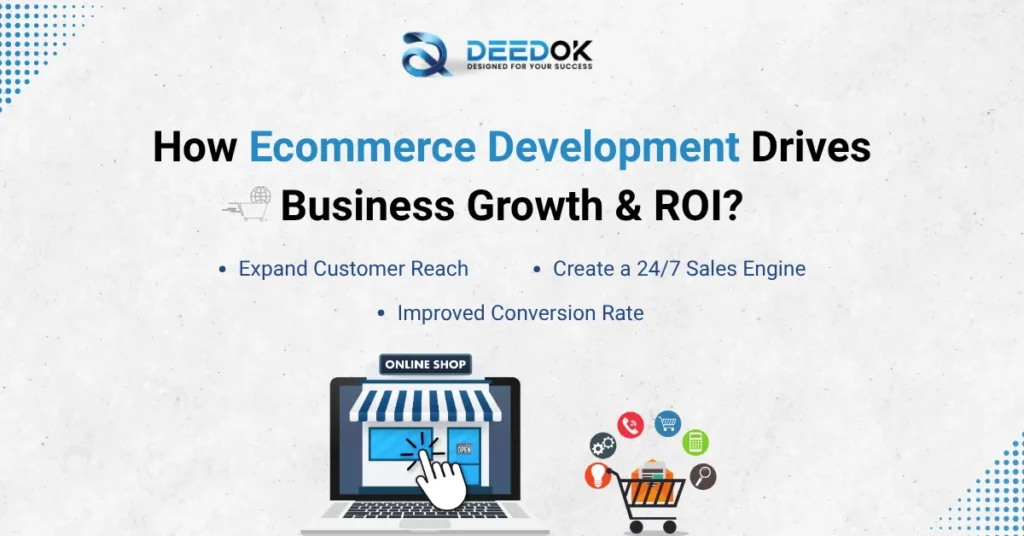
E-commerce development helps increase the amount of sales of the business, growth, and increase the ROI through the following reasons :
Expand Customer Reach
Online commerce sites remove geographic limitations; if a user lives far away, they can still buy the product, as e-commerce stores let them purchase from home whenever they want.
The business owner can expand their market nationally and internationally, covering different states and countries for better business growth, and it also allows the possibility of choosing different languages and currencies.
Create a 24/7 Sales Engine
E-commerce Development can accept orders from anywhere, anytime, giving the e-commerce website an edge over a generic site or a store that only accepts customers during normal business hours.
Improved Conversion Rate
The Ecommerce development website should have these aspects, as it will enhance the user experience and also increase the conversion rate of the website.
Ecommerce Development Factor | How It Improves Conversions |
Faster Loading | Reduces waiting time and helps visitors stay on the website instead of leaving. |
Better Navigation | Makes it easier for customers to find products, categories, and important information. |
Mobile UX | Provides a smooth shopping experience across smartphones and tablets. |
Product Discovery | Improves product search, filters, recommendations, and category organization. |
Site Search | Helps customers quickly find the specific products they want. |
Customer Reviews | Builds trust by showing real experiences, ratings, and feedback from other buyers. |
Checkout Optimization | Reduces unnecessary steps and friction during the purchasing process. |
Multiple Payment Methods | Gives customers convenient payment options and can reduce checkout abandonment. |
Key Modern Technologies Powering Ecommerce Development
Headless Commerce
Headless commerce separates the frontend (what users see and interact with) from the backend (what runs the application).
It helps the website run smoothly, and businesses should consider this approach because it provides faster page load times.
Managing separate frontend and backend channels can be complex, but it gives online commerce sites an added advantage: a strong backend and a visually engaging frontend.
A.I Powered Performance
Today, AI improves the shopping experience by using modern e-commerce technologies, such as machine learning and natural language processing, to enhance the user experience.
Personalized Recommendations
The latest machine learning algorithms analyze user patterns through their previous website history, along with the user’s location and wishlist, and then provide recommendations.
Integrating AI in E-commerce Development helps improve user retention and analyze users’ buying patterns.
Automated Customer Support
Integrating chatbots into the application makes it easy to manage customer queries without user intervention; chatbots can handle a large volume of queries at any time and reduce the business’s operational costs.
Security & Payment Infrastructure
The most important aspect of e-commerce website development is security and payment infrastructure, as integrating a secure payment gateway is essential, and storing users’ data safely and maintaining privacy is also critical for every business.
E-commerce SEO
Many people confuse e-commerce SEO with general SEO and focus on finding relevant keywords, but that’s only the basic part. Modern online commerce sites should have a proper structure, relevant internal linking, and content written to follow GEO guidelines so search engines and AI systems can understand what products you sell.
Element | What It Means | Why It Matters |
Product Structured Data | Schema markup that tells search engines details such as product name, price, availability, rating, and brand. | Helps search engines understand products and can support enhanced search results. |
ProductGroup / Variant Schema | Structured data that connects different versions of the same product, such as size, color, or model. | Helps search engines understand product variations instead of treating every variant as unrelated. |
Google Merchant Center | A platform where businesses provide Google with product information and feeds. | Helps products become eligible for relevant Google shopping experiences. |
Product Feeds | Structured files containing product details such as title, price, image, availability, and URL. | Keeps product information synchronized with shopping platforms and search systems. |
Crawlable Category Architecture | Categories and subcategories should be accessible through normal links and organized logically. | Makes it easier for search engines to discover and understand your product hierarchy. |
Internal Linking | Links between related categories, products, guides, and other pages. | Helps distribute authority and allows crawlers and users to discover more products. |
Clean URLs | Simple URLs such as /mens/shoes/running-shoes/. | Makes URLs easier for users and search engines to understand. |
Search-Friendly Product Information | Clear product titles, descriptions, specifications, FAQs, images, and relevant attributes. | Gives search engines and AI systems more reliable information to interpret product intent. |
Essential Steps to Build a Scalable Ecommerce Development Strategy
-
Define business requirements
-
Select the Right E-commerce Architecture
-
Plan UX and Conversion Architecture
-
Build Essential Integrations
- Payment gateways
- CRM systems
- ERP software
- Product Information Management (PIM)
- Inventory management
- Shipping and logistics platforms
- Analytics tools
- Marketing automation platforms
-
Optimize SEO, performance, and GEO.
-
Test before launch
-
Optimizing the Website After Launch
- Revenue
- Conversion rate
- Search visibility
- Page speed
Conclusion
Ecommerce Development is not merely about building an online shop, but about building a digital ecosystem that organizations need to attract visitors, manage their companies better, offer a better buying experience, and improve revenues.
Each technology choice made during Ecommerce Development can have a long-lasting effect. For instance, it can be the selection of the platform, design with a focus on conversions, the implementation of systems used for company operations, search engine optimization, and more.
Whether you are a small company building your first ecommerce website or a popular brand looking to grow your ecommerce strategy, your ecommerce development strategy should be based on your customers, requirements, budget, and growth objectives.
Ecommerce Development can be a one-way gateway to success, or it can be a long-lasting part of your core business operations that helps you maintain a competitive presence at all times.
Frequently Asked Questions
Ecommerce development lets organizations reach consumers online, streamline processes, make purchasing easier, boost conversions, and drive growth.
Depending on requirements like whether you need a customized ecommerce website, integrations, size, and the platform you select, prices can vary substantially.
Depending on your specific business needs, SaaS and non-SaaS ecommerce platforms each have benefits. SaaS is easier to set up and get live fast, while custom ecommerce software supports complex workflows, extensive integrations, and greater control.
It depends on the scale of the project, but generally a smaller ecommerce store can be built in a couple of weeks, while a larger, more extensive project takes longer.
Customers frequently use mobile devices to buy online.
When it is set up properly, an e-commerce website can provide a consistent customer experience with fewer obstacles in the checkout process.
Comments (0)
Leave a Comment