
 Deedok IT Solutions
Content is king – you must have heard this line if you are in the digital space. Many companies offer content marketing strategy for business growth, but do you know what a content marketing strategy includes? It includes creating content for real readers or users in your niche who want to follow you, and the content plan generally includes the AEO and GEO order. It should measure business outcomes across all social, search, and owned channels.
Users’ search habits have changed a lot recently; most people search questions in AI mode for quick answers, and they use large language models like ChatGPT, Perplexity, Claude, and Gemini for research and recommendations. People also ask about the content plan from these models. There has been a report about the recent use of Google AI; you might be shocked to hear that Google AI has surpassed more than 1 billion monthly users.
Define Intent & Entity-Driven Buyer Profiles
- Informational
- Commercial
- Transactional
- Navigational
- It is recommended to do strong research and also do some sort of competitor research to analyze and find the content gaps and add it to our content.
- Add short videos to the digital marketing content for detailed explanations, and it demonstrates the services they offer.
- The content plan should include case studies of the content, and it also helps in the evaluation of the projects that they have worked on in the past.
- The content plan should also include page comparisons to help users understand the advantages of partnering with your company.
Build Topical Authority via Pillar-Spoke Content Clusters
It is recommended to create one strong pillar of content, which is the base, or we can say the main content, that the company offers and surround it with related content. For example, if your company is in website development, you should create one strong pillar of content around it, like a main page. There will be sub-sections involving different services that come under the web development services, which are as follows :
Creating one strong pillar of content generally helps you build strong supporting pages around it. Plan content around users’ search intent, and have it directly answer their questions. It should also allow case studies and support long-tail searches, which can improve the website’s user experience.
Modern content creation firms generally provide user-friendly content instead of keyword stuffing, which often feels irrelevant. A strong content marketing strategy builds content in depth; if it’s meaningful, it will rank naturally.
A strong content strategy includes supporting articles on subtopics, and the content plan should often include sections like FAQs and comparisons.
Start with a pillar page covering the broad subject. Then create supporting articles around subtopics, FAQs, comparisons, examples, implementation questions, tools, mistakes, costs, and industry-specific use cases.
Traditional Keyword Strategy | Topical Cluster Architecture |
One keyword per page | One subject with related entities |
Focus on search volume | Focus on intent and topic coverage |
Isolated blog posts | Interconnected pillar and spoke pages |
Short-term ranking goal | Long-term authority development |
Exact-match optimization | Natural semantic relationships |
Mostly traffic-focused | Traffic, visibility, trust, and conversion |
Architect an Answer-First & GEO-Optimized Content Plan
- An effective content plan often structures content around user intent and includes a variety of internal links, along with a proper publication date. A modern content plan supports writing direct, clear answers in a structured format.
- At the top of the content, include a clear, concise answer that saves the user time and improves the experience. Writing clear, concise answers is often called answer engine optimization, and many people no longer prefer traditional search results; they rely on modern AI platforms, like large language models, to answer their questions.
- Writing content for large language models is known as generative engine optimization, as the age of traditional search is over and people prefer direct answers and AI overviews in their search results.
- Therefore, it is recommended to follow proper structure and use modern technologies; modern content creation firms use these technologies in their content plans.
Architect an Answer-First & GEO-Optimized Content Plan
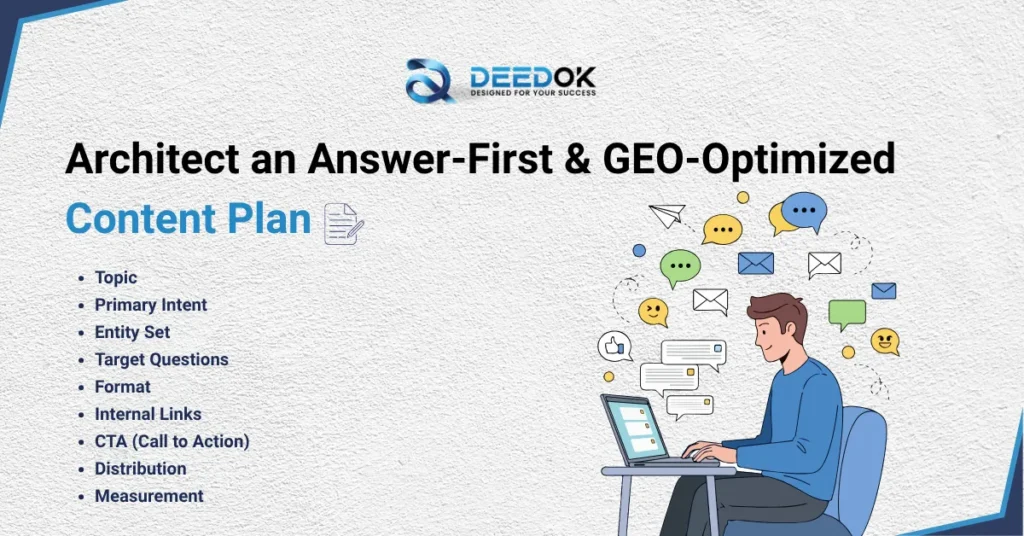
Element | Details to Define |
Topic | What is the main subject or theme of the content? |
Primary Intent | What is the visitor trying to accomplish—learn, compare, buy, solve a problem, or take action? |
Entity Set | Which specific people, places, products, services, brands, or concepts should be mentioned? |
Target Questions | What exact questions is the reader likely to ask about the topic? |
Format | Format explains how the content should be presented, such as the use of headings and lists. |
Internal Links | Which relevant pages, blogs, service pages, or resources on your website should this content link to? |
CTA (Call to Action) | What action should the reader take next—contact the company, request a quote, sign up, purchase, or read another resource? |
Distribution | Where will the content be promoted or discovered—Google Search, AI search engines, |
Measurement | Which KPIs will determine success—organic traffic, rankings, impressions, clicks, engagement, conversions, leads, or sign-ups? |
For clear understanding by both humans and AI, it is recommended to use a clear heading structure that follows the content hierarchy: the main heading should be H1, sub-sections should be H2, other sections should be H3, and further content should be H4.
Keep the content user-friendly; it should be direct, clear, and concise. Keep the content short; use short paragraphs and lists to keep readers engaged.
Build Lead Generation Content Marketing Loops
- Modern content marketing strategy is not just about publishing SEO-optimized content; the content plan should include useful, relevant content that drives sales and increases website conversions.
- For example, if a user is searching for a very basic topic, they may search on AI platforms and prefer not to read content on a dedicated website. This is a major problem for many business owners, and it affects website engagement rates.
- The solution is to create high-value content with a strong hook that compels users to click through to your website.
| Content Type | Purpose / Examples |
| Data & Research | Original data, surveys, research findings, industry benchmarks, and proprietary insights. |
| Interactive Tools | Calculators, quizzes, assessments, estimators, and other interactive experiences. |
| Actionable Assets | Ready-to-use templates, checklists, worksheets, playbooks, and step-by-step frameworks. |
| Decision Helpers | Product comparisons, buyer guides, comparison pages, case studies, and customer success stories. |
| Community | Live webinars, expert discussions, deep-dive newsletters, online communities, and private groups. |
- When people click through to the website to read the content, add it in short form with questions tied to the company’s goals, and ask about company size and budget, since that information reveals a lot about their plans.
Scale Execution: In-House Team vs Content Creation Firm
- If you want to partner with a company to enhance your website’s features but aren’t sure whether to choose an in-house team or a content creation firm, start by deciding on your content volume.
- The in-house team generally has strong product knowledge, but they may lack the ability to scale content.
- An in-house team provides strong product knowledge and close access to subject-matter experts. However, scaling research, editorial production, multimedia, technical SEO, and distribution may require additional specialists.
| In-House Content Team | Partnering with a Content Creation Firm |
| Deep internal business knowledge. | Broader external specialist expertise. |
| Strong daily collaboration. | Flexible production capacity. |
| Easier access to internal SMEs. | Access to editors, strategists, SEO specialists, and designers. |
| Higher fixed staffing cost at scale | Variable or retainer-based operating model. |
| Strong brand control. | Requires clear governance and review. |
| Best for constant strategic ownership. | Useful for scaling execution and specialized programs. |
Measure 2026–2027 Content Performance Metrics
- Use a balanced scorecard to measure content, accounting for search visibility, AI visibility, engagement, qualified leads, pipeline contribution, and revenue, rather than relying only on pageviews.
- SEO metrics generally remain an important part of a content marketing strategy for 2026, but additional metrics also matter for improving content visibility.
- Track Share of Voice (SoV) – Share of Voice generally means how many times the name of your brand comes in the answers of large language models and other AI platforms. For example, if an AI answers a prompt 100 times, mentions your brand 40 times, and mentions your competitors 20 times, your SoV is much stronger than your competitors’.
- LLM Reference Rate – The LLM Reference Rate is how often the AI mentions your brand name when it is answering relevant questions; the higher the LLM reference rate, the higher the chance of visibility.
- Although these are useful operational metrics, no universal industry standard exists for either. Instead, treat them as internal measurement systems rather than as official search-engine scores.
- Google has likewise added specific performance reporting for Generative AI in Search Console, enabling users to see the number of impressions generated by generative AI features such as AI Overviews and AI Mode. Google completed this rollout for all websites worldwide by August 31, 2026.
Your dashboard should include:
- SEO involves impressions, clicks, rankings, indexed pages, and organic conversions.
- AI visibility includes AI impressions, Citation SoV, LLM Reference Rate, brand mentions, and cited URLs.
- Engagement includes engaged sessions, return visits, and content-assisted conversions.
- Revenue: marketing-qualified leads, sales-qualified leads, pipeline contribution, closed revenue.
A useful formula is:
Content ROI = Attributed Pipeline or Revenue ÷ Total Content Investment
As a result, leaders get a clearer indication of whether content is producing business value.
90-Day Implementation Roadmap
A lasting Content Marketing Strategy for 2026 to 2027 combines an understanding of audience intent, topical authority, an answer-first approach to architecture, AI to assist with execution, first-party data, and revenue-focused measurement.
Days 1–30: Build the foundation
Review the current content, flag outdated pages, analyze buyer intent, identify priority entities, and group content into topic clusters. Set up baseline figures for organic search and generative AI visibility.
Days 31–60: Build and optimize
Set up or update pillar pages, supporting articles, comparison pages, case studies, and lead magnets. Enhance internal linking, structured data, author information, answer-first formatting, and the conversion pathways.
Days 61–90: Scale and measure
Start AI-assisted workflows with human approval, reuse your research across channels, test new conversion materials, and set up monthly reporting for SEO, AI visibility, leads, the pipeline, and revenue.
The main point is that the best Content Marketing Strategy for 2026 to 2027 isn’t the one that produces the most content, but the one that continually generates original, useful, and trustworthy information to gain attention from people, search engines, and AI systems.
Conclusion
As time advances, the content marketing strategy also evolves. During 2026-2027, the content plan is generally not about publishing more content but about delivering user-friendly content aligned with users’ intent; it is about publishing content that is SEO, AEO, and geo-optimized, as people have shifted toward quick AI summaries from Google and other large language models.
A strong content plan includes in-depth competitor research to identify content gaps and incorporate those insights; it should also include clear CTAs, which generally increase conversions.
Comments (0)
Leave a Comment